
Table of Contents
- Is Moissanite Worth the Money? The Direct Answer
- Moissanite vs Diamond: What Actually Differs
- Moissanite Cost: What You'll Actually Pay
- Moissanite Durability for Everyday Wear
- Moissanite Resale Value: What You Get Back
- Who Should Buy Moissanite (And Who Shouldn't)
- Quality, Certification, and What to Verify
- Frequently Asked Questions
Last Updated: October 11, 2026
Is Moissanite Worth the Money? The Direct Answer
Moissanite is worth the money if you want a durable stone with diamond-like appearance at 70-80% less cost. Whether moissanite worth the money depends on your priorities: appearance, durability, and budget.
But here's what matters most: moissanite isn't a perfect diamond substitute. It has more fire and sparkle, which some love and others find too flashy. It won't hold resale value like a natural diamond. And if you're investing in a stone expecting to recoup your money later, moissanite isn't the play.
The real question isn't whether moissanite is worth buying, it's whether it's worth buying for you. Below, we'll show you exactly how to make that call.
Moissanite vs Diamond: What Actually Differs
Moissanite and diamond differ in three ways: appearance, durability, and resale value. Both are real gemstones but fundamentally different materials.
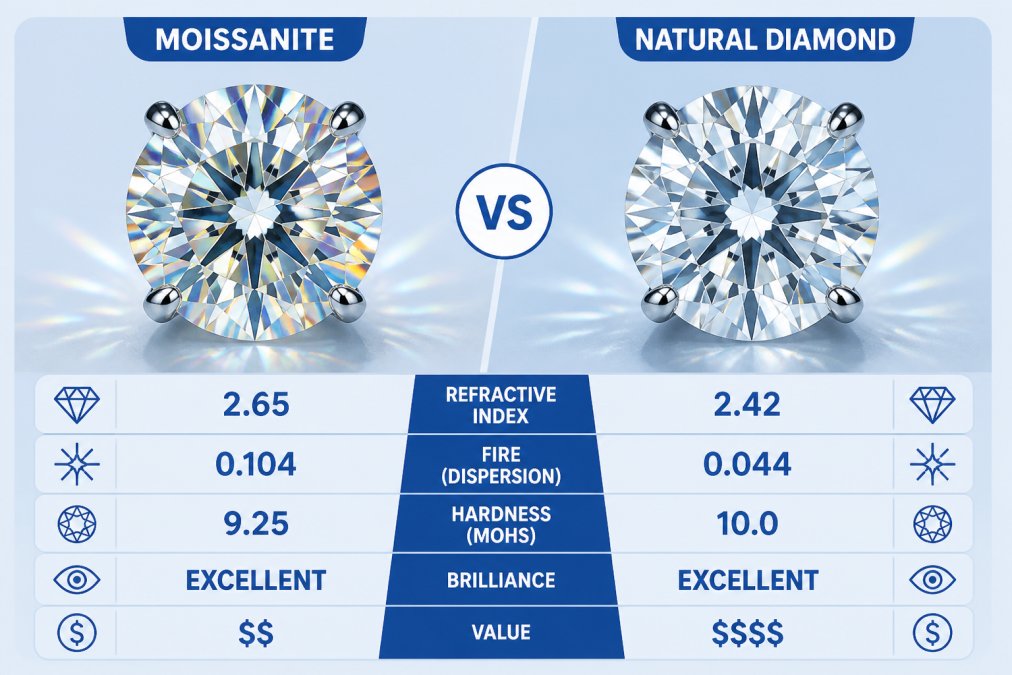
Moissanite is lab-created silicon carbide. Diamonds are natural carbon or lab-grown carbon. That's the whole story chemically, but it matters because it changes how light behaves inside each stone.
Appearance, Brilliance, and Fire
Moissanite's biggest visual difference is sparkle: it creates visible rainbow flashes in sunlight, while diamonds reflect light more subtly. Some love the fire; others prefer diamond's quieter brilliance.
Newer cuts of VVS1 moissanite are engineered to minimize sparkle compared to older cuts, but the difference remains visible in daylight. Indoor lighting shows less contrast.

Color is another factor. Diamonds come in grades from D (colorless) to Z (light colored). Most moissanite is D-color, which means it's as colorless as the best diamonds. This is a win for moissanite, you're getting the highest color grade without paying premium diamond prices.
Hardness and Scratch Resistance
Moissanite ranks 9.25 on the Mohs hardness scale; diamonds are 10. Both resist scratching in normal use. The difference matters only for extreme conditions like grinding against concrete.
Moissanite lasts a lifetime without clouding, cracking, or dulling.
Moissanite Cost: What You'll Actually Pay
Moissanite costs 80% less than diamond. A 2-carat moissanite ring costs $300-500 versus $3,000-8,000 for diamond.
Price Ranges by Style and Size
834jewelry's VVS1 Moissanite Solitaire Ring starts at $44.99 (0.5ct-5ct). The Heart Cut Stackable Set is $109.29 (0.8ct), and the Bow Halo Ring is $128.13 (1.2ct).

These prices show what moissanite worth the money means: premium quality at accessible levels versus $500-2,000+ for equivalent diamond rings.
Total Ownership Costs Over Time
Moissanite's value includes total cost of ownership. Professional cleaning costs $20-50/year; resizing or band repairs cost $50-150, but the stone needs no work.
Diamonds require upfront cost plus insurance, appraisals, and maintenance. Moissanite costs less to insure and replace.
Moissanite Durability for Everyday Wear
Moissanite is built for daily wear. It's durable enough for engagement rings, work rings, and pieces you wear constantly. The stone won't degrade, cloud, or lose its sparkle from normal use.
How Moissanite Performs Under Daily Use
Moissanite at 9.25 on the Mohs scale handles scratches, bumps, and daily contact without damage. It resists temperature changes, humidity, and chemical exposure.
The 925 Sterling Silver setting needs attention, the metal can scratch and tarnish, but the moissanite stays flawless.
Caring for Your Stone: Maintenance and Cleaning
Clean weekly with warm water, mild soap, and a soft brush. Dry with a soft cloth. Avoid ultrasonic cleaners and steamers, which can loosen the stone.
Store separately to prevent scratching the metal. Professional cleaning once or twice yearly maintains brilliance.
Moissanite Resale Value: What You Get Back
Resale value is where moissanite diverges most sharply from diamonds. Understanding what you'll actually recover, and why, is essential if you're considering moissanite as a long-term purchase.
The Secondary Market Reality
Moissanite has a thin resale market. Secondhand moissanite typically sells for 15-40% of retail price, depending on seller type and stone quality.
Natural diamonds recover 40-60% of retail; lab-grown diamonds recover 30-50%. The gap exists because diamonds have established grading standards, documented provenance, and a larger buyer pool.
Where You Can Sell and What to Expect
Your resale options affect what you'll recover:
Jeweler Trade-In: Expect 20-30% of original price. Jewelers offer this for convenience and to encourage upgrades.
Online Marketplaces: Private sales on Facebook Marketplace, Etsy, or resale sites net 25-40% of retail but require handling shipping and disputes.
Pawn Shops and Consignment: Pawn shops offer 10-20% of retail. Consignment shops offer 30-40% but take 30-50% commission, lowering net recovery.
Donation: Donating allows a tax deduction based on fair market value (typically 50-70% of retail).
Total Cost of Ownership: The Real Financial Picture
When evaluating whether moissanite is worth the money, compare the total cost of ownership, not just the purchase price:
Moissanite Example (1.2-carat solitaire):
- Initial purchase: $300-500
- Annual cleaning/maintenance: $20-50/year × 10 years = $200-500
- Insurance (optional): $30-60/year × 10 years = $300-600
- Resizing or setting repair (one-time): $75-150
- Total 10-year cost: $875-1,750
- Resale recovery (30% of original): $90-150
- Net cost after resale: $725-1,600
Diamond Example (0.5-carat solitaire, comparable visual size due to moissanite's brightness):
- Initial purchase: $2,000-3,500
- Annual cleaning/maintenance: $30-75/year × 10 years = $300-750
- Insurance: $60-120/year × 10 years = $600-1,200
- Appraisal (every 3-5 years): $100-200 total
- Total 10-year cost: $3,000-5,650
- Resale recovery (50% of original): $1,000-1,750
- Net cost after resale: $2,000-3,900
Moissanite's total cost of ownership is substantially lower even after resale. The gap matters only if you plan to sell or view it as an investment.
VVS1 Moissanite Solitaire Ring | 925 Sterling Silver | GRA Certified | Passes →
Investment vs. Personal Wear: Which Matters to You
The resale value question hinges on your intent:
Buy moissanite if: You're purchasing for personal wear and don't plan to sell. You want to maximize the size and quality of the stone for your budget. You're comfortable with the stone having no investment value.
Consider a diamond if: You're buying an heirloom piece you expect to pass down and want it to hold or appreciate in value. You may sell within 5-10 years and want better resale recovery. You want the peace of mind of owning a stone with established resale markets and grading standards.
Hybrid approach: Some buyers purchase a moissanite engagement ring for daily wear and a smaller diamond as a secondary piece or future heirloom. This balances affordability with the security of owning a stone that holds value.
Who Should Buy Moissanite (And Who Shouldn't)
Whether moissanite is worth the money depends on your priorities, budget, and expectations. Use this framework to evaluate if moissanite aligns with what you actually want.
The Moissanite Decision Matrix
Priority: Maximum Size for Budget A $500 moissanite budget gets you 1.5-2 carats; the same budget for diamonds gets 0.3-0.5 carats. This matters most for engagement rings.
Priority: Durability and Low Maintenance Moissanite requires less specialized care than diamonds, no annual appraisals or special insurance riders.
Priority: Appearance (Sparkle vs. Subtlety) Moissanite's higher refractive index creates visible rainbow flashes, especially in sunlight. Some love this; others find it too sparkly.
Priority: Invisibility to Others Moissanite is close to diamond but not perfect to the naked eye. Trained jewelers can identify it under magnification.
Quality Factors That Affect Your Choice
Not all moissanite is the same. Understanding grading helps you evaluate whether you're getting true value.
Color Grade (D-Z Scale) Most moissanite is D-color (colorless), the highest grade, without diamond premiums. Lower grades may appear yellow or gray. Always verify color grade before purchasing.
Clarity Grade (FL to I3 Scale) VVS1 (very, very slightly included) is excellent and flawless to the naked eye. Lower grades may show visible inclusions.
Cut Quality Cut determines sparkle, brilliance, and fire.
Certification and Verification Look for moissanite that comes with independent certification (GRA, GCAL, or similar). This verifies the stone's authenticity, color, and clarity.
Best For: Specific Use Cases
Engagement Rings: Moissanite is excellent for engagement rings if you want a large, durable stone without diamond's cost. The sparkle is more noticeable but most find it appealing. If your partner prefers subtlety, choose diamond or lab-grown diamond.
Everyday Jewelry (Earrings, Pendants, Bracelets): Moissanite is ideal for constant wear. Low cost justifies multiple pieces; durability means no worry about damage. Moissanite studs at $15-30 deliver sparkle without diamond anxiety.

Statement Pieces: For large stones (3+ carats), moissanite delivers dramatic impact at a fraction of diamond cost. Extra sparkle becomes a feature.
Skip Moissanite If:
You need invisibility. If the stone must pass as a diamond under professional inspection, buy a diamond or lab-grown diamond.
You hate sparkle. If you've seen moissanite in person and found the fire too obvious or artificial-looking, a diamond's subtler brilliance will serve you better.
You're buying an investment. If you expect the stone to appreciate or hold significant resale value, diamonds (especially certified natural diamonds) are the only option.
You want a family heirloom with financial value. Moissanite has no established secondary market or collector value.
You're uncertain about the appearance. If you haven't seen moissanite in person under various lighting, don't buy online. The appearance difference is real, and it's the most common reason buyers regret moissanite purchases.
Quality, Certification, and What to Verify
All moissanite from 834jewelry is GRA certified and VVS1 graded. This means every stone meets rigorous quality standards.
GRA Certification and Diamond Tester Verification
GRA certification guarantees every 834jewelry moissanite stone is genuine, high-quality, and graded accurately, your proof of authenticity.
Moissanite passes diamond testers due to similar electrical properties. This is a selling point, your moissanite looks and tests like a diamond.
VVS1 Grading: What It Means for Your Stone
VVS1 is the second-highest clarity grade, meaning very slight inclusions invisible to the naked eye. VVS1 moissanite is flawless to your eye for life.
The question of whether moissanite is worth the money has a clear answer: yes, if you're buying for personal wear and want durability at an accessible price. 834jewelry delivers GRA-certified VVS1 moissanite jewelry crafted in 925 Sterling Silver that passes diamond testers and delivers the sparkle and confidence you're looking for. Whether you choose a solitaire ring, stackable engagement set, or moissanite earrings, you're getting premium quality that lasts a lifetime. Explore our collection and find the piece that's right for you.
Frequently Asked Questions
Is moissanite worth the money compared to a diamond?
Moissanite offers exceptional value if you prioritize upfront affordability and durability. A 1-carat moissanite costs a fraction of a natural diamond while delivering comparable brilliance and lasting 10+ years with proper care. However, moissanite holds minimal resale value, so it's worth the money only if you're buying for personal wear, not as a financial investment. For engagement rings and everyday pieces, the cost savings justify the choice for most buyers.
How much does moissanite cost, and what affects the price?
Moissanite pricing ranges from $16.50 for solitaire stud earrings to $128.13 for halo engagement rings, depending on stone size, cut, and setting material. The 834jewelry collection offers GRA-certified VVS1 moissanite in 925 sterling silver, with solitaire rings starting at $44.99. Price increases with carat weight and design complexity, but even larger stones remain significantly cheaper than natural diamonds of equivalent size.
Does moissanite hold its resale value?
Moissanite resale value is minimal, expect 20-30% of your original purchase price at best. Unlike diamonds, moissanite doesn't trade on secondary markets and lacks established resale channels. If you're buying primarily as an investment, moissanite is not worth the money. However, if you're purchasing for personal wear and plan to keep the piece, resale value is irrelevant to your decision.
Is moissanite durable enough for everyday wear?
Yes. Moissanite rates 9.25 on the Mohs hardness scale, making it durable for daily wear in rings, earrings, and bracelets. It resists scratching and withstands typical impact from daily activities. The main durability consideration is maintaining its clarity, moissanite can develop a cloudy appearance if exposed to oils and residue over months of constant wear. Regular cleaning with warm soapy water prevents this and keeps your stone brilliant.
Will moissanite look fake or get cloudy after a year of wearing it daily?
Moissanite won't become permanently cloudy if you maintain it. The 'cloudy' appearance some report comes from oil buildup and surface residue, not from the stone degrading. Cleaning your piece weekly with mild soap and warm water restores full brilliance. GRA-certified VVS1 moissanite from 834jewelry passes diamond testers and maintains its clarity indefinitely with basic care, no special treatments needed.