

Table of Contents
- Why Some Moissanite Stones Pass Diamond Testers
- Thermal vs Electrical Conductivity Diamond Testers: The Core Difference
- What Stones Will Pass a Diamond Tester? A Quick Comparison
- How to Tell If Moissanite Is Real: Visual Cues vs Mechanical Testing
- GRA Certified Moissanite Meaning: Why Certification Matters
- Tester Calibration and Maintenance: Avoiding False Readings
- Limitations of Handheld Testers and When You Need a Gemologist
- Conclusion: Choose Stones That Test Right and Look Right
- Frequently Asked Questions
Last Updated: September 7, 2026
Why Some Moissanite Stones Pass Diamond Testers
Moissanite stones that pass diamond testers do so because moissanite conducts heat nearly as efficiently as natural diamond. Standard handheld diamond testers measure thermal conductivity, not chemical composition, so when the probe tip touches a moissanite stone, the heat dissipates at a rate that falls within the detection range for diamond, producing a "positive" reading.
At 834jewelry, we work exclusively with VVS1 moissanite engineered to perform on these standard devices. This is why sellers advertise "passes diamond tester" as a selling point, it is a measurable property of the stone's crystal structure, not a gimmick.
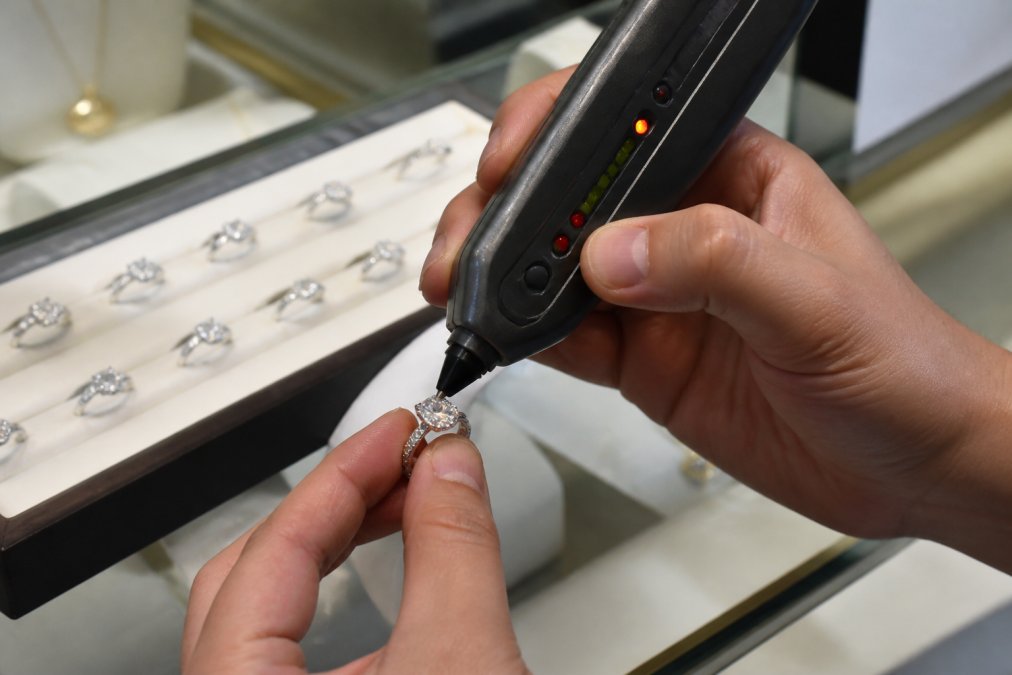
The catch is that this only applies to thermal testers. The moment you introduce electrical conductivity testing, the results change completely.
Thermal vs Electrical Conductivity Diamond Testers: The Core Difference
A thermal vs electrical conductivity diamond testers comparison comes down to what each device measures. Thermal pens measure how quickly heat moves through a stone; moissanite and diamond both dissipate heat rapidly, which is why moissanite triggers a false positive on these pens.
Electrical conductivity testers measure how well a stone conducts electricity, and here the two gems diverge sharply. Natural diamond is an electrical insulator, meaning it does not conduct electricity (mineralseducationcoalition.org). Moissanite, by contrast, is a semiconductor. When an electrical tester touches moissanite, the device reads the conductivity and flags the stone as moissanite rather than diamond.
This distinction matters for anyone shopping for moissanite diamond testers results. A standard $15 thermal pen will tell you a moissanite stone is a diamond; a professional electrical tester will correctly identify it as moissanite. Neither device is wrong, they measure different physical properties.
What Stones Will Pass a Diamond Tester? A Quick Comparison
| Tester Type | Method | Moissanite Result | Diamond Result | Typical Price Range |
|---|---|---|---|---|
| Standard Thermal Pen | Heat transfer | Passes as diamond | Passes as diamond | $15 - $50 |
| Electrical Conductivity Tester | Electrical current | Identified as moissanite | Passes as diamond | $200+ |
| Combined Thermal + Electrical | Both methods | Identified as moissanite | Passes as diamond | $250+ |
For most buyers, the practical takeaway is straightforward: if you are verifying a stone with a basic thermal pen, moissanite will pass. If you need certainty about whether a stone is genuinely diamond, you need a tester that checks electrical conductivity.
Thermal Conductivity Testers (Standard Pens)
These are the pens most people own or encounter at jewelry counters. They are affordable, simple to operate, and effective at weeding out glass, cubic zirconia, and most other simulants. Moissanite, with its high thermal inertia, performs nearly identically to diamond on this test.
Electrical Conductivity Testers (Moissanite Detectors)
Professional-grade devices like the RS Mizar Oris Terminator II combine thermal and electrical testing in one unit, designed to catch moissanite that fools standard pens. The tradeoff is cost, several hundred dollars, but for a jeweler or serious collector, that investment eliminates guesswork.
How to Tell If Moissanite Is Real: Visual Cues vs Mechanical Testing
A diamond tester answers the thermal question, but it cannot tell you if a stone is well-cut, well-polished, or genuinely what the seller claims. Visual inspection is the other half of the equation. Here is what to look for, starting with the most reliable indicators.
The Facet Junction Test: Sharpness and Doubling
Under 10x magnification, look at the junctions where two facets meet. On a well-cut diamond, these lines are crisp and perfectly straight. On moissanite, because it is doubly refractive, you will often see a faint doubling of the facet lines when looking through the stone at an angle. Moissanite's facet junctions are also often slightly less sharp than a diamond's, though high-end cutters achieve excellent polish; in lower-grade stones, rounded or wavy junctions are a telltale sign.
To perform this test: place the stone table-down on a white surface, hold a 10x loupe close to your eye, and focus on the girdle area. Look through the stone at the opposite side. If you see the girdle edge doubled, you are seeing double refraction. A diamond will show a single, sharp line.
The Fire Test: Color Flash Distribution
Moissanite has a dispersion rate of 0.104, more than double diamond's 0.044, meaning it splits white light into spectral colors more aggressively (gemologyproject.com). Under a single overhead light source, a diamond shows primarily white brilliance with occasional small flashes of color near the girdle, while moissanite throws larger, more frequent rainbow flashes across the entire crown. Use a single point light source, not diffuse fluorescent lighting, which washes out the effect.
The Fog Test: A Quick but Imperfect Check
Breathe on the stone as if fogging a mirror. A diamond disperses heat so quickly that the fog evaporates within one to two seconds; moissanite clears slightly slower, in two to four seconds. This test is not definitive, a cold diamond holds fog longer, and a warm moissanite clears faster, so use it only as a preliminary check.
The Dot Test: A Simple Refraction Check
Draw a small dot on white paper and place the stone table-down directly over it. Looking through the pavilion, a diamond shows a single, clear image; moissanite shows the dot doubled or slightly offset due to double refraction. This works best on round brilliant cuts with a shallow pavilion and is less reliable on step cuts or deep pavilions.
The Needle Test: Spotting the Inclusions
Under 10x magnification, look for inclusions. Natural diamonds often contain tiny crystals, feathers, or pinpoints, while most commercial moissanite is VVS or better, clean at 10x. A completely flawless stone claimed to be natural diamond is a red flag; flawless natural diamonds exist but are rare and expensive, so a clean stone at a bargain price is more likely moissanite or another lab-grown material.
The Lighting Angle Test: Brilliance vs Fire
Tilt the stone under a direct light source. A diamond maintains steady white brilliance across a wide range of angles, while moissanite can appear dark or "dead" at certain angles, then burst into intense fire at others. Moissanite's higher refractive index (2.65-2.69 vs diamond's 2.42) creates more total internal reflection, making it more sensitive to tilt, a "blinking" effect that is a moissanite signature.
Combining Visual and Mechanical Tests
No single visual test is foolproof. The reliable approach is to run two or three visual checks and one mechanical test. If the stone passes the thermal tester and shows sharp facet junctions with minimal doubling, you are likely looking at a diamond; if it passes but shows clear doubling and intense rainbow fire, it is moissanite. Combining tests eliminates the blind spots of each method.
GRA Certified Moissanite Meaning: Why Certification Matters
GRA certified moissanite meaning comes down to third-party verification of the stone's quality. The Gemological Research Association provides documentation confirming a stone's clarity grade, color grade, and authenticity as laboratory-grown moissanite, the difference between trusting a seller's word and having documented proof.
A GRA certificate typically lists the stone's carat weight, clarity grade, and color grade, backing claims like VVS1 clarity and D-color. Without it, you are relying on the seller's description alone.
At 834jewelry, every piece ships with GRA certification, and customers frequently confirm the stones register correctly on their own testers. As one buyer noted, "I hit it with the diamond tester and it passed too." That combination of documented quality and real-world verification separates a confident purchase from a gamble.
Tester Calibration and Maintenance: Avoiding False Readings
A common mistake is assuming a diamond tester is always accurate straight out of the box. Accuracy depends on calibration, battery level, probe tip condition, and the stone's ambient temperature.
Before testing, allow the stone to reach room temperature, as a cold stone dissipates heat faster and can skew the reading. Test a known diamond first to confirm calibration; if the device fails to register it, recalibrate or replace the battery.
Dirt, oil, or residue on the probe tip insulates it and slows heat transfer, producing unreliable readings. Clean the tip with a soft cloth between tests, especially when checking multiple stones in one session.
Limitations of Handheld Testers and When You Need a Gemologist
Even the best handheld testers measure one physical property at the surface of a stone. Here are the specific scenarios where a tester will let you down.
The Diamond-Coated Simulant Problem
A thermal pen reads the surface it touches. If a manufacturer applies a thin diamond coating, often via chemical vapor deposition, to cubic zirconia or synthetic corundum, the probe contacts a layer that conducts heat like diamond, registering a pass on a stone that is not diamond. No handheld tester can see through the coating; the only reliable detection is spectroscopy or high-magnification inspection of facet junctions, where the coating often shows wear.
The Setting and Mounting Trap
When a stone is set in a closed-back ring or bezel setting, the surrounding metal acts as a heat sink, dissipating the probe's heat and producing a false negative, the tester says "not diamond" even when the stone is genuine. Jewelers recommend testing a stone before mounting, or at minimum testing a loose stone of known identity first. On a finished piece, press the probe firmly against the table and hold it steady for the full reading window; a shaky hand or partial contact is another common source of error.
The Temperature and Environmental Variables
Thermal testers are calibrated for room temperature (68-77°F) (nist.gov). A stone from a cold car or near an AC vent has a lower surface temperature, slowing heat dissipation and potentially pushing the reading into the "simulant" zone; a stone warmed by body heat or display lighting can read artificially high. Let the stone acclimate on a non-conductive surface for 5-10 minutes before testing, and avoid direct sunlight or heat lamps.
The Dirty Probe Problem
Hand oils, lotion, and dust are invisible insulators that build a microscopic barrier on the probe tip, slowing heat transfer and causing false negatives on stones that should pass. Professional jewelers clean the tip with isopropyl alcohol on a lint-free cloth between every few tests, a habit worth adopting when testing multiple stones.
When a Gemologist Is the Only Answer
A handheld tester answers one question: does this stone conduct heat and electricity like diamond or moissanite? It cannot tell you if a stone is lab-grown or natural, whether it has been treated to improve color, or whether it is HPHT versus CVD diamond. For those questions, you need a gemological laboratory, the GIA and AGS use advanced instruments like FTIR and photoluminescence spectroscopy to identify growth method and treatment history. This matters for insurance appraisals, estate purchases, or any stone valued above a few thousand dollars where provenance affects price.
The Practical Threshold
For most moissanite buyers, the decision point is straightforward. Verifying a $50 moissanite ring purchased online requires only a thermal pen plus a visual double-refraction check. Buying a stone described as natural diamond for $5,000 requires a laboratory report. The middle ground is a combined thermal-electrical tester like the RS Mizar or GemOro, which catches moissanite that fools basic pens, but no handheld device replaces a trained gemologist when financial stakes are high.
Conclusion: Choose Stones That Test Right and Look Right
The moissanite that passes diamond testers is not a rare anomaly; it is the expected behavior of a stone with thermal conductivity nearly identical to diamond. The real question is whether you are buying from a source that stands behind the stone's quality with certification and craftsmanship.
At 834jewelry, our VVS1 moissanite is GRA certified, set in 925 Sterling Silver, and engineered to register correctly on standard thermal testers. Every piece is designed for the fire and brilliance that makes moissanite a compelling choice, backed by documentation that verifies what you are getting. Shop the collection and find a piece that tests right and looks even better in person.
Frequently Asked Questions
Can moissanite stones pass a diamond tester?
Yes, most moissanite stones pass standard thermal conductivity diamond testers. These pens measure how quickly heat moves through the stone. Moissanite's thermal conductivity is close enough to diamond that it triggers a positive reading. However, advanced electrical conductivity testers detect moissanite because it conducts electricity differently than diamond. If you want a stone that passes the common thermal pen test, VVS1 moissanite from 834 Jewelry delivers that result consistently.
Which diamond tester can detect moissanite?
Electrical conductivity testers detect moissanite. Devices like the RS Mizar Oris Terminator II combine thermal and electrical testing to distinguish diamond from moissanite. Standard thermal pens, which many casual buyers use, cannot tell the difference. If you are buying moissanite that passes standard diamond testers, understand that a jeweler with an electrical tester will identify it as moissanite. That is expected and does not mean the stone is low quality.
What is GRA certified moissanite meaning for diamond tester results?
GRA certification confirms the stone's quality grades: clarity, cut, color, and carat weight. For diamond tester results, GRA certification means the stone meets documented standards for VVS1 clarity and high thermal conductivity. The certificate itself does not guarantee a tester result, but it verifies you received the moissanite grade you paid for. When you buy GRA-certified moissanite from 834 Jewelry, the stone is designed to pass standard thermal testers, and the certificate backs up its quality claims.
Why do some moissanite stones trigger diamond testers?
Moissanite triggers thermal diamond testers because of its high thermal conductivity. Heat moves through moissanite almost as fast as through diamond, so the tester's probe registers a positive result. The crystal structure of moissanite, silicon carbide, conducts heat efficiently in all directions. This is why standard thermal pens cannot separate the two stones. Only testers that also measure electrical conductivity can tell them apart, since moissanite conducts electricity while diamond does not.