
Table of Contents
- Does Moissanite Get Cloudy Over Time? The Short Answer
- Why Does My Moissanite Look Dull? 5 Real Causes
- Moissanite Oil Slick Removal: What It Is and How to Fix It
- How to Clean Moissanite Rings at Home (Step-by-Step)
- Moissanite vs. Diamond: Durability, Hardness, and Cloudiness
- Is Cloudiness Permanent? Myths vs. Reality
-
How to Spot Cloudiness Before It Kills Your Sparkle
- Step 1: The Tilt Test (Is It the Stone or the Surface?)
- Step 2: The Breath Test (Oil vs. Clean)
- Step 3: The Edge Check (Oil Slick vs. Mineral Film)
- Step 4: The Underside Check (Setting Debris)
- Step 5: The Prong Check (Loose Stone)
- Cloudy vs. Dirty vs. Damaged: The Decision Guide
- When It Is Not Cloudiness at All
- Long-Term Care: Keeping Your Moissanite Brilliant for Years
- Frequently Asked Questions
Last Updated: September 14, 2026
Does Moissanite Get Cloudy Over Time? The Short Answer
No, does moissanite get cloudy over time in the way most people fear. Moissanite is a lab-grown silicon carbide gemstone with a refractive index of 2.65 to 2.69, higher than diamond's 2.42, and a 9.25 rating on the Mohs scale (gia.edu). The cloudiness people notice after months of daily wear is almost always surface buildup, not a change inside the stone. At 834jewelry, we hear this question constantly from buyers wondering whether their VVS1 stones will hold their fire. They will, if you understand what actually causes that hazy look.

Why Does My Moissanite Look Dull? 5 Real Causes
Dullness in a moissanite ring is a surface problem, not a stone problem. Silicon carbide does not oxidize, fade, or lose internal clarity with age. What changes is the film on the crown facets, which scatters light before it can reflect back to your eye.

Surface Buildup: Oils, Lotions, and Soap Scum
Sebum, hand lotion, sunscreen, and soap residue form a thin organic film across the crown. Because moissanite's brilliance depends on light entering and exiting clean facets, even a microscopic layer cuts sparkle. The tell is a soft, milky glow uniform across the whole stone rather than in one spot. This is the most frequent cause and the easiest to reverse.
Hard Water Film and Mineral Residue
Hard water leaves calcium carbonate and magnesium deposits behind after it dries (Hardness of Water). Over weeks, those minerals build a chalky layer that looks like fog inside the stone. This residue bonds to the surface rather than sitting loosely on top, and it often reappears within a day or two if the ring is not dried completely. The tell is a white, powdery haze near the prongs and under the stone, where water pools and evaporates last.
Micro-Scratches and Abrasions from Daily Wear
Moissanite resists scratching from most household contact, but the metal setting does not. Prongs and bezels pick up abrasions that dull the overall look, and grit trapped against the stone can create fine surface marks over decades. This is the one cause that is genuinely cumulative rather than reversible with a wash. The tell is a loss of sharpness at the facet edges under a loupe or bright lamp, not a uniform haze. A jeweler can polish the metal and re-tighten prongs, restoring most of the perceived brilliance.
Chemical Reaction Specifics: What Actually Causes the Film
The moissanite itself is chemically inert under normal household exposure. The setting is not.
- Chlorinated pool water. Chlorine attacks the copper alloy in sterling silver and some lower-karat gold alloys, producing compounds that appear as a dark or grayish haze (pubmed.ncbi.nlm.nih.gov). That residue migrates onto the pavilion of the stone, where it reads as cloudiness. The stone is fine; the metal is reacting.
- Sunscreen and self-tanners. These contain avobenzone, oxybenzone, and titanium dioxide, all oil-soluble and adhering strongly to facet edges. They do not rinse off with water alone. The tell is a slightly yellow or iridescent cast that appears within hours and resists a plain water rinse.
- Ammonia-based cleaners and some hair products. Ammonia and the thioglycolates in depilatories and perms can tarnish silver and dull gold alloys, leaving a film that transfers to the stone. The tell is a grayish or bluish tint after cleaning the house or a salon visit.
- Hairspray and perfume. These leave a lacquer-like film that is invisible until it accumulates. The tell is a gradual loss of fire over weeks rather than a sudden change.
The practical takeaway: when a stone looks cloudy after swimming, sunscreen, or ammonia cleaning, the cause is almost always the setting chemistry, not the gem. Plain water will not fix it; you need a surfactant (mild dish soap) to lift the oil-soluble film, and for chlorine tarnish, a jeweler's polishing cloth on the metal.
Setting-Related Cloudiness
A loose prong lets the stone shift, trapping dirt underneath where no toothbrush can reach. Closed-back, halo, and pave settings are the worst offenders because debris has nowhere to escape. The tell is asymmetric: one side looks hazier than the other, or the haze forms a ring under the stone rather than across the crown. Check the setting before blaming the gem. A jeweler can tighten a prong and clean underneath in one visit, resolving a surprising share of "my moissanite went cloudy" complaints.
Moissanite Oil Slick Removal: What It Is and How to Fix It
An oil slick on moissanite is an iridescent, rainbow-tinted film on the surface, not inside the stone. It forms when oils, cosmetics, or hard water minerals bond to the facet edges and refract light in a thin-film pattern. Removal is straightforward: soak the piece in warm water with a drop of mild dish soap for 10 to 15 minutes, then scrub gently with a soft-bristled brush. For stubborn slicks, a 50/50 mix of warm water and white vinegar breaks down the mineral bond. Never use chlorine bleach, which attacks the silver alloy in the setting.
How to Clean Moissanite Rings at Home (Step-by-Step)
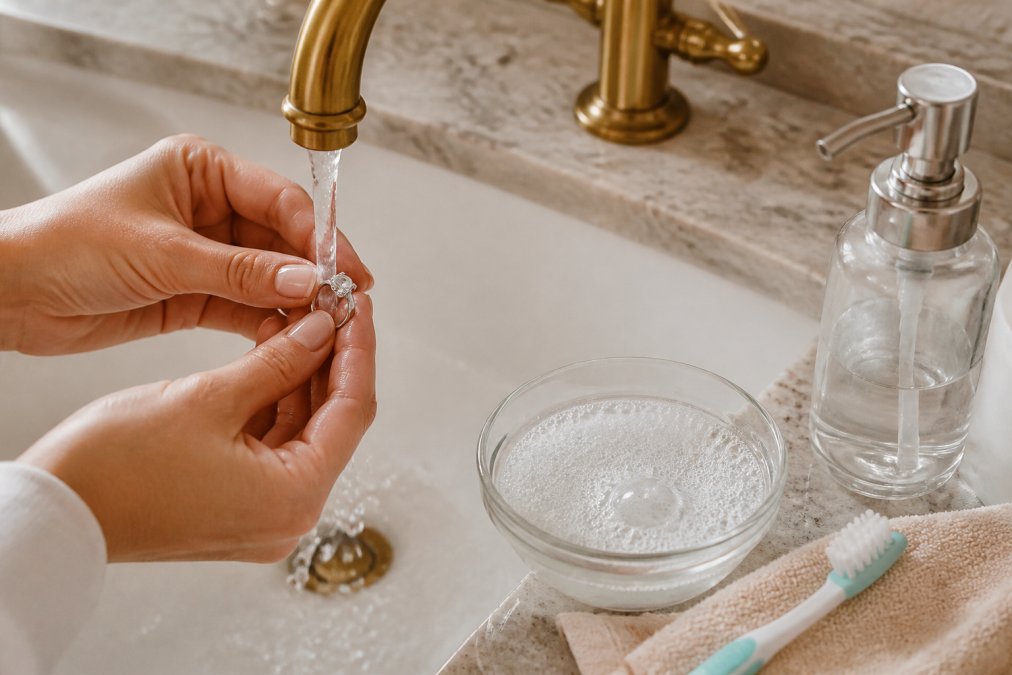
Cleaning moissanite rings at home takes about 15 minutes and requires no special equipment. The goal is to lift oils and minerals without abrading the metal or stone.
What You'll Need
- Mild dish soap, unscented and dye-free
- Warm water, not hot
- A soft-bristled toothbrush or a dedicated jewelry brush
- A microfiber cloth
- An ultrasonic cleaner, optional but effective for deep cleaning
- A small bowl for soaking
The 6-Step Cleaning Routine
- Fill a bowl with warm water and one drop of mild dish soap.
- Soak the ring for 10 to 15 minutes to loosen oils and residue.
- Brush gently around the prongs, under the stone, and along the band.
- Rinse under warm running water with the drain closed.
- Pat dry with a microfiber cloth, then let it air dry completely.
- Inspect the prongs for looseness before wearing.
For ultrasonic cleaner use, run a three-minute cycle with a drop of soap, then rinse and dry. Skip the ultrasonic if your setting has glued elements or fragile stones.
Moissanite vs. Diamond: Durability, Hardness, and Cloudiness
Diamond wins on raw hardness at 10 on the Mohs scale, but moissanite's 9.25 is more than enough for daily wear. The gap that matters is toughness under sideways impact, where diamond's perfect cleavage makes it more prone to chipping. On cloudiness, neither stone clouds from within. Both collect the same surface film from oils and lotions and respond to the same cleaning routine. The practical difference is maintenance cost: diamond owners often pay for professional cleaning, while moissanite responds well to the home routine above.
| Factor | Moissanite | Diamond |
|---|---|---|
| Mohs hardness | 9.25 | 10 |
| Refractive index | 2.65-2.69 | 2.42 |
| Fire (dispersion) | Higher | Lower |
| Cloudiness from within | No | No |
| Surface film buildup | Yes, cleanable | Yes, cleanable |
| Typical home cleaning | 15 minutes | 15 minutes |
Is Cloudiness Permanent? Myths vs. Reality
Cloudiness in moissanite is temporary in nearly every case. The myth that moissanite "goes cloudy" permanently comes from owners who never cleaned their stones, or from settings that trapped debris for years. Silicon carbide does not oxidize, fade, or lose clarity with age. What can be permanent is physical damage, a deep scratch or a chipped facet from a hard impact. Those require a jeweler's assessment, not a cleaning. If your stone stays hazy after two proper cleanings, get a professional inspection rather than assuming the worst.
How to Spot Cloudiness Before It Kills Your Sparkle
Most guides tell you to clean your ring. Almost none tell you how to figure out what you are looking at first. Run these checks in order and you will know within a minute whether your stone needs a wash, a jeweler, or nothing.
Step 1: The Tilt Test (Is It the Stone or the Surface?)
Hold the ring under a single bright lamp and slowly tilt it through a full rotation. A clean stone throws sharp, distinct flashes of fire that snap on and off as the facets catch the light. A filmed stone throws a soft, milky glow with no sharp flashes. If the flashes are sharp but the stone looks dim, the problem is likely the setting or metal, not the crown. If the flashes are soft and diffuse, you are looking at surface film.
Step 2: The Breath Test (Oil vs. Clean)
Breathe on the stone the way you would to fog a mirror. On a clean surface, the fog clears in about two seconds. On an oily surface, the fog lingers for five seconds or more and often leaves a visible smudge. It is the fastest test for organic film and costs nothing.
Step 3: The Edge Check (Oil Slick vs. Mineral Film)
Look at the facet edges under bright light, angling the stone so the edges catch a highlight. Rainbow or iridescent tints signal an oil slick, an oil film refracting light in a thin-film pattern. A uniform white or gray haze with no rainbow signals mineral residue or tarnish. The two need different fixes: oil slicks respond to dish soap and warm water, while mineral film often needs a diluted white vinegar soak.
Step 4: The Underside Check (Setting Debris)
Flip the ring and inspect beneath the stone with a flashlight. Dark or cloudy patches under the pavilion mean trapped debris in the setting, not a problem with the gem. This is the most commonly misdiagnosed cause of "cloudy moissanite," because the haze appears to come from inside the stone when it is actually behind it.
Step 5: The Prong Check (Loose Stone)
Wiggle each prong gently with a fingernail. Any movement means the stone is loose and needs a jeweler before it is worn again. A loose stone is not a cloudiness problem, but it causes the asymmetric haze described above, and it should stop you from wearing the ring until fixed.
Cloudy vs. Dirty vs. Damaged: The Decision Guide
Use this to interpret what you found:
| What you see | What it means | What to do |
|---|---|---|
| Uniform milky haze, breath fog lingers | Organic film (oils, lotion, soap) | Warm water + mild dish soap soak, soft brush |
| White powdery haze near prongs | Hard water minerals | Diluted white vinegar soak, then rinse and dry fully |
| Rainbow tint at facet edges | Oil slick | Dish soap soak; repeat if it returns within days |
| Gray or bluish tint after pool or cleaning | Metal tarnish transferring to stone | Jewelry polishing cloth on metal; avoid chlorine exposure |
| Asymmetric haze, one side duller | Loose prong or trapped debris | Jeweler visit to tighten and clean underneath |
| Haze persists after two proper cleanings | Possible surface damage or deep-set residue | Professional inspection before assuming the worst |
When It Is Not Cloudiness at All
Two things get mislabeled as cloudiness. First, a chipped or abraded facet edge scatters light differently than a clean facet, reading as a dull patch rather than a haze. Second, a stone that was always lower clarity (an I-grade or included stone) will look hazier than a VVS stone from day one, and no cleaning changes that. If your stone looked brilliant when you bought it and looks hazy now, it is film or debris. If it never looked brilliant, it is the stone's clarity grade, and the fix is a conversation with your seller, not a toothbrush.
Long-Term Care: Keeping Your Moissanite Brilliant for Years
Long-term brilliance comes down to frequency, not intensity. A 30-second rinse after heavy wear prevents the film from hardening into a stubborn layer. Store moissanite separately from other jewelry to avoid metal-on-metal abrasions, and take rings off before swimming, cleaning with chemicals, or applying lotion. A yearly professional inspection catches loose prongs and setting wear before they become expensive problems. With that routine, a VVS1 moissanite stone from 834jewelry holds its fire and clarity for decades. Each piece is GRA certified and passes diamond testers, so the quality you inspect on day one is the quality you keep.
Frequently Asked Questions
How do I remove cloudiness from moissanite?
Cloudiness on moissanite is almost always surface buildup, not the stone itself. Mix a few drops of mild dish soap with warm water, soak the ring for 10-15 minutes, then scrub gently with a soft-bristle toothbrush. Rinse and dry with a lint-free microfiber cloth. For stubborn oil slick films, use a jewelry-safe cleaner or an ultrasonic cleaner. If the haze stays after cleaning, have a jeweler inspect the setting and prongs for trapped residue or scratches.
Why does my moissanite look dull after wearing it every day?
Daily wear coats the stone in skin oils, lotion, sunscreen, and soap scum. These form a thin film that blocks light from entering the stone, so it looks hazy instead of fiery. Hard water leaves mineral deposits that do the same thing. Moissanite itself does not dull with age, but the film on top of it does. Clean it weekly with mild soap and warm water, and your stone will look as bright as the day you bought it.
Does moissanite lose its sparkle over time?
No. Moissanite ranks 9.25 on the Mohs scale, so it resists scratching far better than most gemstones. Its refractive index of 2.65 gives it more fire and brilliance than diamond, and that property never fades. What fades is the cleanliness of the stone's surface. Regular cleaning with a microfiber cloth and mild cleaning solution keeps the sparkle intact. Only physical damage like deep scratches or chips can permanently reduce light return.
Is moissanite better than cubic zirconia for long-term wear?
Yes, by a wide margin. Cubic zirconia rates around 8 to 8.5 on the Mohs scale and gets scratched and cloudy within months of daily wear. Moissanite at 9.25 holds its clarity, fire, and polish for decades. CZ also lacks moissanite's double-refraction, which gives moissanite its distinctive sparkle. If you want a stone that stays clear and brilliant through years of daily use, moissanite is the stronger choice.
Moissanite dullness is a maintenance issue, not a flaw in the stone. The buyers who get years of unbroken sparkle are the ones who clean on a schedule and inspect their settings before small problems grow. 834jewelry builds every piece from premium VVS1 Moissanite set in genuine 925 Sterling Silver, GRA certified and designed to pass diamond testers, so the stone you buy is the stone that keeps its fire. Explore the collection and find a piece built to stay brilliant.