
Table of Contents
- Moissanite vs Diamond for Hip Hop: Quick Comparison
- What Is Moissanite and Why It Dominates Iced-Out Culture
- Do Diamond Testers Work on Moissanite?
- VVS1 Moissanite Quality: What You Actually Get
- Cost of Custom Iced-Out Jewelry: Moissanite vs Diamond
- Where Moissanite Wins and Where Diamonds Still Lead
- Frequently Asked Questions
Last Updated: September 11, 2026
Moissanite vs Diamond for Hip Hop: Quick Comparison
The moissanite vs diamond debate in hip hop comes down to one question: does the piece hit hard enough to flex, and can you afford to actually wear it? Moissanite is a lab-grown silicon carbide gemstone that outshines diamond in fire and dispersion while costing a fraction of the price. For iced-out culture, that math changes everything, because the whole point of the aesthetic is surface area. More stones, bigger chains, louder wrist presence.
Here's the honest verdict up front: moissanite wins for hip hop jewelry in almost every practical category. It throws more colored fire, it passes handheld diamond testers, and it lets you build a fully iced-out setup without a mortgage. Diamond still holds an edge in resale value and in the specific status signal that comes from owning a mined stone. Everything else favors moissanite.
| Factor | Moissanite | Natural Diamond | Winner |
|---|---|---|---|
| Fire and dispersion | Higher, more rainbow flash | Lower, more white brilliance | Moissanite |
| Mohs hardness | 9.25 | 10 | Diamond |
| Cost for iced-out scale | A fraction of diamond | Prohibitive at scale | Moissanite |
| Diamond tester result | Passes handheld testers | Passes | Tie |
| Resale value | Low | Moderate to high | Diamond |
| Ethical sourcing | Lab-grown, traceable | Mining-dependent | Moissanite |
What Is Moissanite and Why It Dominates Iced-Out Culture
Moissanite is a lab-grown gemstone made of silicon carbide, first discovered in meteorite fragments and now produced synthetically for jewelry. Its refractive index sits higher than diamond's, which is why the stones throw that rainbow dispersion the culture calls "bling."
The reason moissanite took over iced-out jewelry is scale. A buss down piece is defined by how many stones cover the surface, and moissanite lets you cover far more surface for the same money. At 834jewelry, every piece is built around VVS1-grade stones in 925 sterling silver, GRA certified and designed to pass a diamond tester, so the flex holds up when someone actually checks.

Refractive Index and Light Dispersion
Diamond's refractive index is 2.42. Moissanite's is roughly 2.65, and its dispersion is higher too. That higher dispersion is the technical reason moissanite shows more colored fire under direct light, the rainbow flash that reads as "iced out" from across a room.
Why Moissanite Is Popular in Hip Hop Culture
Hip hop jewelry has always been about visual impact per dollar. Moissanite delivers the same iced-out read at a price that lets artists, athletes, and everyday fans wear the aesthetic daily instead of locking it in a safe.
Gemological Institute of America gemstone reference
Do Diamond Testers Work on Moissanite?
This is the single most misunderstood topic in iced-out jewelry, and most guides either skip it or get it wrong. The short answer: it depends entirely on which tester is being used. There are three common types, and they behave very differently on moissanite.
Thermal (Heat) Testers
A standard handheld thermal pen tester measures how quickly heat moves through the stone. Diamond conducts heat extremely well, so the pen beeps "diamond." Moissanite also conducts heat in a similar range, which is why a thermal pen will typically flag moissanite as diamond too. This is the tester you'll see at a mall kiosk, a pawn shop, or a jeweler's counter.
That result cuts both ways. It's why moissanite passes the tester at the club or the counter, and it's also why a passing thermal result proves almost nothing about identity. It confirms thermal conductivity, not what the stone actually is.
Electrical Conductivity (Multitesters)
Multitesters measure electrical conductivity, not heat. Most natural diamonds conduct electricity only if they are Type IIb, a small minority. Moissanite conducts electricity readily. A multitestor set to the diamond/moissanite mode will separate the two reliably. The catch: most retail counters and almost no club bouncers own one, so in practice you rarely encounter this test outside a serious gem lab or a high-end appraiser.
UV / Fluorescence Testers
Under shortwave UV, many diamonds fluoresce blue, while moissanite typically does not. This is a weak signal on its own, plenty of diamonds show no fluorescence, but it can be a useful cross-check when combined with other methods.
What This Means at the Counter
If you're buying a piece and the seller's only proof is "it passed the tester," you have not verified anything. A thermal pass is consistent with diamond, moissanite, and several other simulants. The practical sequence for a hip hop buyer is:
- Ask which tester was used. Thermal pen = weak proof. Multitestor = strong proof.
- Ask for the GRA certificate. A GRA certificate ties a specific stone grade to a specific piece. This is the document that actually identifies the stone.
- Cross-check the certificate number. A seller who can produce the number on request knows their inventory. A seller who can't is guessing.
- Look at the stone under a loupe. Moissanite shows doubling of facet edges under magnification (birefringence) that diamond does not. This is the one visual check a trained eye can use.
For hip hop buyers, the practical takeaway is simple: the tester is a vibe check, the certificate is the proof. Buy the certificate, not the beep.
VVS1 Moissanite Quality: What You Actually Get
VVS1 is a clarity grade meaning very, very slightly included, with inclusions so minor they're difficult to spot even under magnification. On moissanite, VVS1 stones read as clean and colorless to the naked eye, which is exactly what iced-out jewelry needs.
What most guides miss is that cut quality matters more than the clarity grade for how a piece actually looks. A VVS1 stone with a lazy cut will sit dull in the setting. A well-cut stone in a claw setting catches light from every angle and throws fire across the whole chain.
When you're evaluating a piece, check these in order:
- Stone grade stated as VVS1 or better, with GRA certification
- Cut described as round brilliant, the standard for maximum fire
- Setting type named, claw settings hold stones securely and expose more surface
- Metal purity confirmed at 925 sterling silver or better
- Finish options listed, white gold, yellow gold, or rose gold plating
- Diamond tester pass confirmed by the seller
Cost of Custom Iced-Out Jewelry: Moissanite vs Diamond
Custom iced-out pricing scales with stone count, metal weight, and setting labor, and that's where the gap between the two stones becomes dramatic. A diamond version of the same design can cost many times the moissanite version, because the stone cost dominates the total.
Here's what the moissanite side of that equation looks like in practice:
| Piece | Price | Material | Certification |
|---|---|---|---|
| VVS1 Moissanite Tennis Chain & Bracelet | $78.30 | 925 Sterling Silver | GRA Certified |
| VVS1 Moissanite Cuban Chain | $138.00 | 925 Sterling Silver | Passes Diamond Tester |
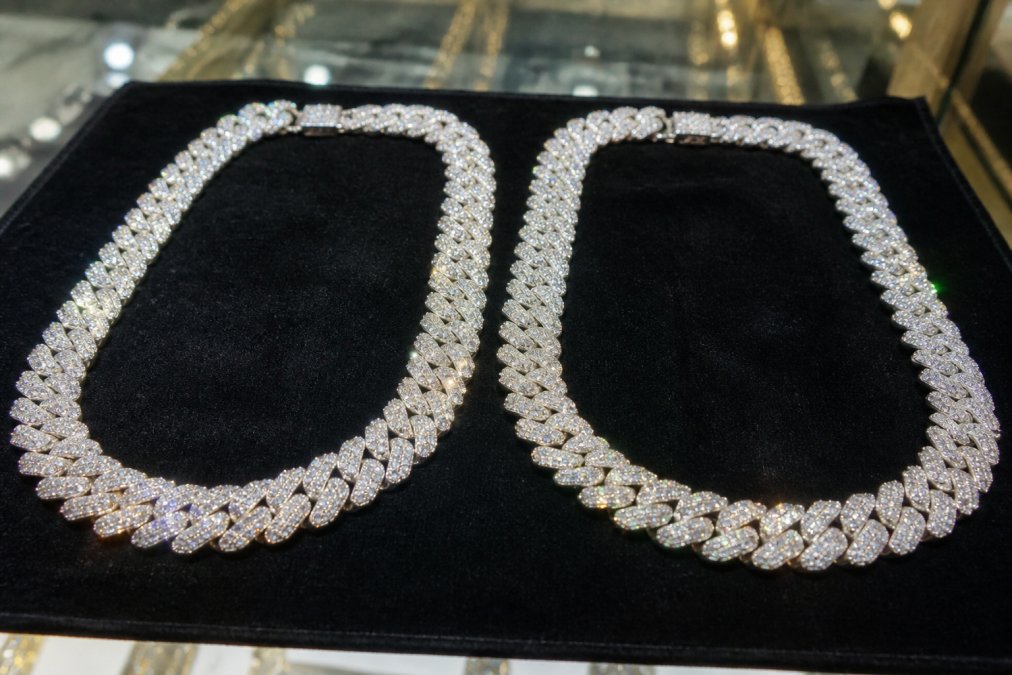
| Buss Down VVS1 Moissanite Cuban Link Chain | $217.06 | 925 Sterling Silver | GRA Certified |
| VVS1 Moissanite Cross Pendant Necklace | $249.99 | 925 Sterling Silver | Passes Diamond Tester |
| VVS1 Moissanite Automatic Watch | $499.00 | 904L Stainless Steel | Passes Diamond Tester |
A diamond equivalent of the buss down Cuban alone would run into five figures. That difference is the entire reason moissanite owns this category.

Federal Trade Commission jewelry advertising guidance
Where Moissanite Wins and Where Diamonds Still Lead
Moissanite wins on fire, on affordability, on ethical sourcing, and on how much ice you can put on your body for a given budget. It also wins on durability for daily wear: at 9.25 on the Mohs hardness scale, it resists scratching far better than most gemstones and holds up to everyday use.
Diamond keeps two real advantages. It's a 10 on the Mohs scale, so it's marginally harder, and it holds resale value in a way moissanite does not. If you're buying as an investment piece rather than a flex piece, that matters.
The Resale Reality, Stated Plainly
This is the part most guides soften, and it's the part that matters most if you ever plan to sell. Moissanite has almost no secondary market compared to diamond. The reasons are structural, not a knock on the stone:
- No standardized grading body. Diamond resale runs on GIA certificates that any dealer anywhere can verify. Moissanite runs on GRA certificates that carry far less weight in the resale channel.
- Falling replacement cost. Lab-grown production keeps getting cheaper, so a used moissanite stone competes against a brand-new one at a lower price than what you paid.
- Dealer buy-back is thin. Most jewelers won't make a meaningful offer on secondhand moissanite because they can't resell it at a margin. Pawn shops typically treat it as costume jewelry.
- Diamond has a century-old resale infrastructure. Even a modest natural diamond has a wholesale bid because there's a global market for it. Moissanite does not.
The honest framing: buy moissanite to wear it, not to flip it. If resale value is genuinely part of your plan, moissanite is the wrong stone. If you want maximum ice on your body for the money and you plan to keep it, moissanite is the right stone.
Setting and Metal Quality: The Half of the Purchase Most Buyers Ignore
A great stone in a weak setting will lose stones. In hip hop jewelry, the setting is not a detail, it's half the piece. Here's how the two stones behave differently in the heavy-metal settings that dominate iced-out culture:
Prong and claw settings. These expose the most stone surface and throw the most fire, which is why they dominate Cuban links and tennis chains. Moissanite holds up well here because its hardness (9.25) resists the chipping that softer simulants suffer when prongs shift. The trade-off: prongs snag on clothing and can bend. A well-soldered prong in 925 sterling silver or 904L stainless steel holds far better than a glued or poorly soldered alternative.
Pavé and micro-pavé settings. These pack many small stones tightly for a continuous sheet of ice. Moissanite performs well in pavé because the stones are small and the fire reads as a solid sparkle field. The failure mode is shared with diamond: if the metal work is thin, stones pop out. Ask about the metal thickness behind the pavé, not just the stone grade.
Bezel settings. A metal rim surrounds the stone. This is the most secure setting and the least flashy, because the rim hides the stone's edges. Moissanite in a bezel reads slightly less bright than diamond because diamond's higher refractive index compensates better for the reduced light entry. For maximum flex, prong and pavé beat bezel every time.
Metal choice matters as much as the stone. 925 sterling silver is the standard for affordable iced-out pieces and holds up well with proper rhodium or gold plating. 904L stainless steel is more corrosion-resistant and heavier, which reads as more substantial on the wrist. Both hold moissanite securely. What you want to avoid is unnamed base metals or glued settings, which fail regardless of which stone is set in them.
Mohs hardness scale reference from the National Park Service
Frequently Asked Questions
Do rappers wear moissanite diamonds?
Yes, many rappers and hip hop artists wear moissanite jewelry, especially for iced-out chains and pendants. Moissanite delivers the same visual impact as diamonds at a fraction of the cost, which makes it practical for large statement pieces. The stone's higher refractive index means it actually throws more rainbow flashes than a diamond under club lighting. GRA-certified VVS1 moissanite like the pieces from 834jewelry passes diamond testers, so it holds up to scrutiny.
Does moissanite pass a diamond tester?
Moissanite passes most standard diamond testers because it has similar thermal conductivity to diamond. The tester reads the heat transfer and gives a positive result. However, some advanced testers with separate moissanite detection settings can distinguish between the two. If passing a diamond tester matters to you, look for GRA-certified VVS1 moissanite, which is specifically guaranteed to pass standard tester devices.
Is moissanite considered a fake diamond in hip hop culture?
The perception has shifted significantly. Moissanite is a lab-grown gemstone with its own properties, not a diamond simulant like cubic zirconia. In hip hop culture, what matters most is the visual impact: the ice, the shine, the flex. Moissanite delivers all of that. Many artists wear it openly because the savings let them go bigger on carat weight and chain width. The culture values how it looks, not what a lab report says.
Can you tell the difference between moissanite and diamond in a club setting?
In a dim club with flashing lights, it is nearly impossible to tell moissanite from diamond with the naked eye. Moissanite actually has more fire and dispersion, meaning it throws more colorful flashes under direct light. A diamond has slightly more brilliance, or white light return, but the difference is subtle. Most people will assume any iced-out piece is diamond unless you tell them otherwise.
How does the cost of custom iced-out jewelry compare between moissanite and diamond?
The cost difference is substantial. A moissanite Cuban link chain from 834jewelry starts at $138.00, while a comparable diamond piece would cost thousands. The VVS1 Moissanite Tennis Chain starts at $78.30, and the Buss Down Cuban Link is $217.06. For custom iced-out jewelry, moissanite lets you get a bigger, more detailed piece for the same budget. You get the same visual impact without the diamond markup.